CONFERENCE
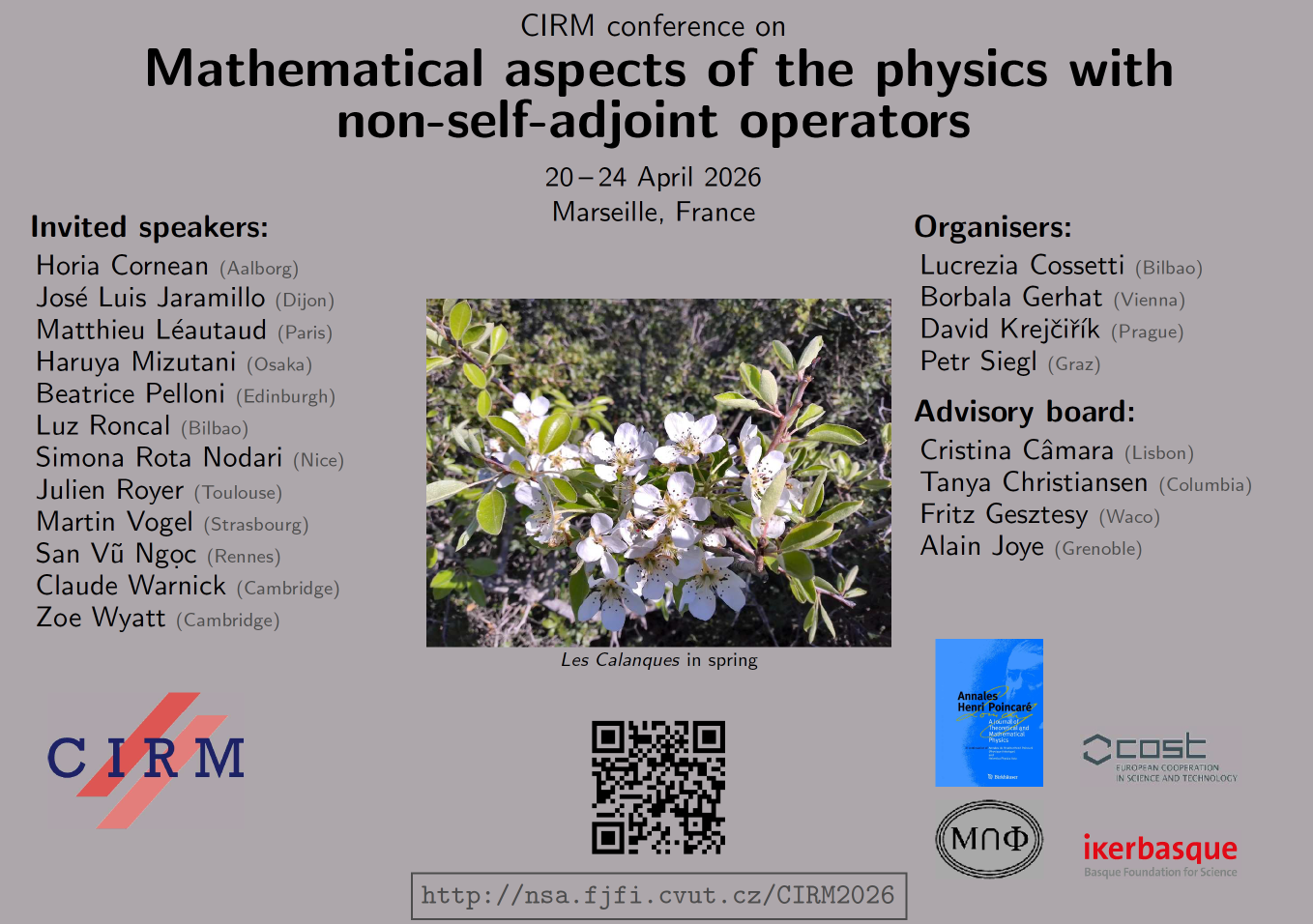
Mathematical aspects of the physics with non-self-adjoint operators
Les aspects mathématiques de la physique avec les opérateurs non-auto-adjoints
20 – 24 April, 2026
Scientific Committee
Comité scientifique
Cristina Câmara (University of Lisbon)
Tanya Christiansen (University of Missouri)
Fritz Gesztesy (Baylor University)
Alain Joye (Université Grenoble Alpes)
Organizing Committee
Comité d’organisation
Lucrezia Cossetti (University of the Basque Country)
Borbala Gerhat (Institute of Science and Technology Austria)
David Krejčiřík (Czech Technical University of Prague)
Petr Siegl (Graz University of Technology)
contact the organizers: nsa@fjfi.cvut.cz
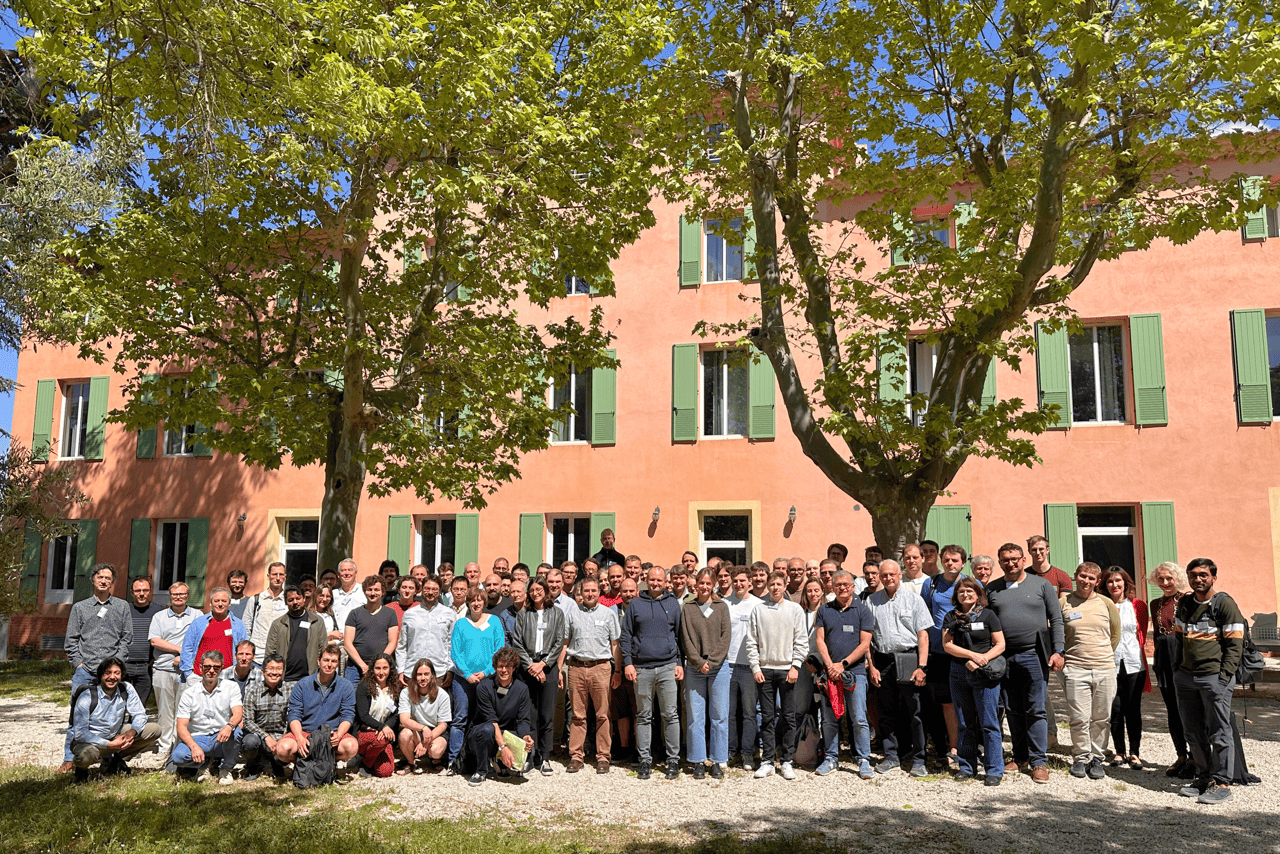
The conference is a follow-up in the MAPwNSA series initiated in 2010 and with meetings held in various places in Europe and North America. The goal is to facilitate interdisciplinary collaborations across the mathematical analysis and mathematical physics communities, with a central object being non-self-adjoint operators and with an essential emphasis on rigorous methods. From the point of view of physics, subjects such as advanced structures in condensed matter and optics, open quantum systems, unconventional representations of observables in quantum mechanics, non-linear phenomena and instabilities in hydrodynamics or general relativity are covered. On the mathematical side, participants are experts in mathematical physics, microlocal, semiclassical, functional and harmonic analysis, spectral theory as well as dynamical systems and partial differential equations. An essential feature of the meeting is the additional focus on the discussion of open problems with the origin ranging from numerical simulations in the concrete physical systems to abstract operator theory.
La conférence est conçue comme prochaine édition de la série de rencontres MAPwNSA initiées en 2010 et organisées en divers lieux en Europe et en Amérique du Nord. L’objectif est de faciliter les collaborations interdisciplinaires entre les communautés de l’analyse mathématique et de la physique mathématique, autour du rôle central joué par la théorie des opérateurs non-auto adjoints et en mettant l’accent sur les méthodes rigoureuses. Du point de vue de la physique, les sujets abordés incluent les structures avancées en physique de la matière condensée et en optique, les systèmes quantiques ouverts, les représentations non conventionnelles des observables en mécanique quantique, les phénomènes non linéaires et d’instabilité en hydrodynamique ou en relativité générale. Du côté des mathématiques, les participants sont des experts en physique mathématique, en analyse microlocale, semi-classique, fonctionnelle et harmonique, en théorie spectrale, ainsi qu’en systèmes dynamiques et en équations aux dérivées partielles. Un élément essentiel de la rencontre est l’accent supplémentaire mis sur la discussion de problèmes ouverts qui vont des simulations numériques des systèmes physiques concrets à la théorie abstraite des opérateurs.
SPEAKERS
Anton Arnold (Vienna University of Technology) Short- and long-time behavior in evolution equations: the role of the hypocoercivity index
Laura Baldelli (Karlsruhe Institute of Technology) Schrödinger operators in electromagnetic fields
Gabriel Cardoso (University of Lisbon) An integrable structure underlying the classical double copy
Cristian Cazacu (University of Bucharest) Hardy-Rellich inequalities with distance function to the boundary and some applications
Horia Cornean (Aalborg University) A spectral and dynamical story related to the classical Euler-Bernoulli polynomial approximation
Rubén De La Fuente Fernández (BCAM Bilbao) An optimal fractional Hardy inequality on the discrete half-line
Irfan Glogić (Bielefeld University) On spectral stability of self-similar solutions to nonlinear wave equations
Denis Grebenkov (CNRS École polytechnique) Mixed Steklov-Neumann-Dirichlet spectral problems: asymptotic analysis and applications
Martin Grothaus (RPTU Kaiserslautern-Landau) Weak hypocoercivity for operator semigroups with non-selfadjoint generator
Martin Halla (Karlruhe Institute of Technology) Analysis of circular waveguides
Jose Luis Jaramillo (Université de Bourgogne Europe) Non-selfadjoint operators in gravity: two case studies
Maryna Kachanovska (INRIA Saclay) Wave Propagation in a Waveguide Filled with a Cold Strongly Magnetized Plasma
Perry Kleinhenz (Illinois State University) Geometry of wave damping on the torus
Matthieu Léautaud (Université Paris Saclay) Small-Time Parametrix for the Fokker-Planck Equation and Applications
Haruya Mizutani (University of Osaka) Large data modified wave operators for the 1D defocusing cubic NLS
Delio Mugnolo (University of Hagen) COST Action CA24122 mSpace
Beatrice Pelloni (Heriot-Watt University) Jumps, cusps and fractals in the solution of dispersive equations
Yehuda Pinchover (Technion Israel Institute of Technology Haifa) Strictly positive optimal Hardy weight via Green potential
Luz Roncal (Basque Center for Applied Mathematics) Uniqueness for discrete equations: a Landis-type perspective
Simona Rota Nodari (Université Côte d’Azur) Stability Analysis of Quantum Dissipative Systems
Julien Royer (Université Paul Sabatier) Energy decay for the wave equation with unbounded damping
Nico Michele Schiavone (Polytechnic University of Madrid) Uniform resolvent estimates for the Heisenberg sublaplacian
František Štampach (Czech Technical University in Prague) The spectral pair for Schrödinger operators with complex integrable potentials
Tom Ter Elst (The University of Auckland) Kato’s inequalityanddegenerateellipticoperators
Christiane Tretter (University of Bern) Essential numerical ranges
Martin Vogel (Université de Strasbourg) Weyl law for the exponentially small singular values of the d-bar operator
San Vũ Ngoc (Université de Rennes) Exponentially sharp spectrum of non-selfadjoint 1D operators via analytic microlocal analysis
Claude Warnick (University of Cambridge) Non-self-adjoint operators and black hole ring-down
Nicolas Weber (Graz University of Technology) Eigenvalues of operator families: A commutativity result with an application to 1D Dirac operators
Zoe Wyatt (University of Cambridge) Stability for relativistic fluids on slowly expanding cosmological spacetimes
SPONSORS