Scientific Committee
Comité scientifique
Liana Heuberger (Aix-Marseille Université)
Anne Pichon (Aix-Marseille Université)
Nicolas Raymond (CNRS, LAREMA, Université d’Angers)
Susanna Zimmermann (University of Basel)
Organizing Commitee
Comité d’organisation
Solene Esnay (Aix-Marseille Université)
Nolwenn Le Quellec (Université Paris-Est Créteil)
Anne Pichon (Aix-Marseille Université)
Nicolas Raymond (Université d’Angers)
Susanna Zimmermann (University of Basel)

IMPORTANT WARNING: Scam / Phishing / SMiShing ! Note that ill-intentioned people may be trying to contact some of participants by email or phone to get money and personal details, by pretending to be part of the staff of our conference center (CIRM). CIRM and the organizers will NEVER contact you by phone on this issue and will NEVER ask you to pay for accommodation/ board / possible registration fee in advance. Any due payment will be taken onsite at CIRM during your stay.
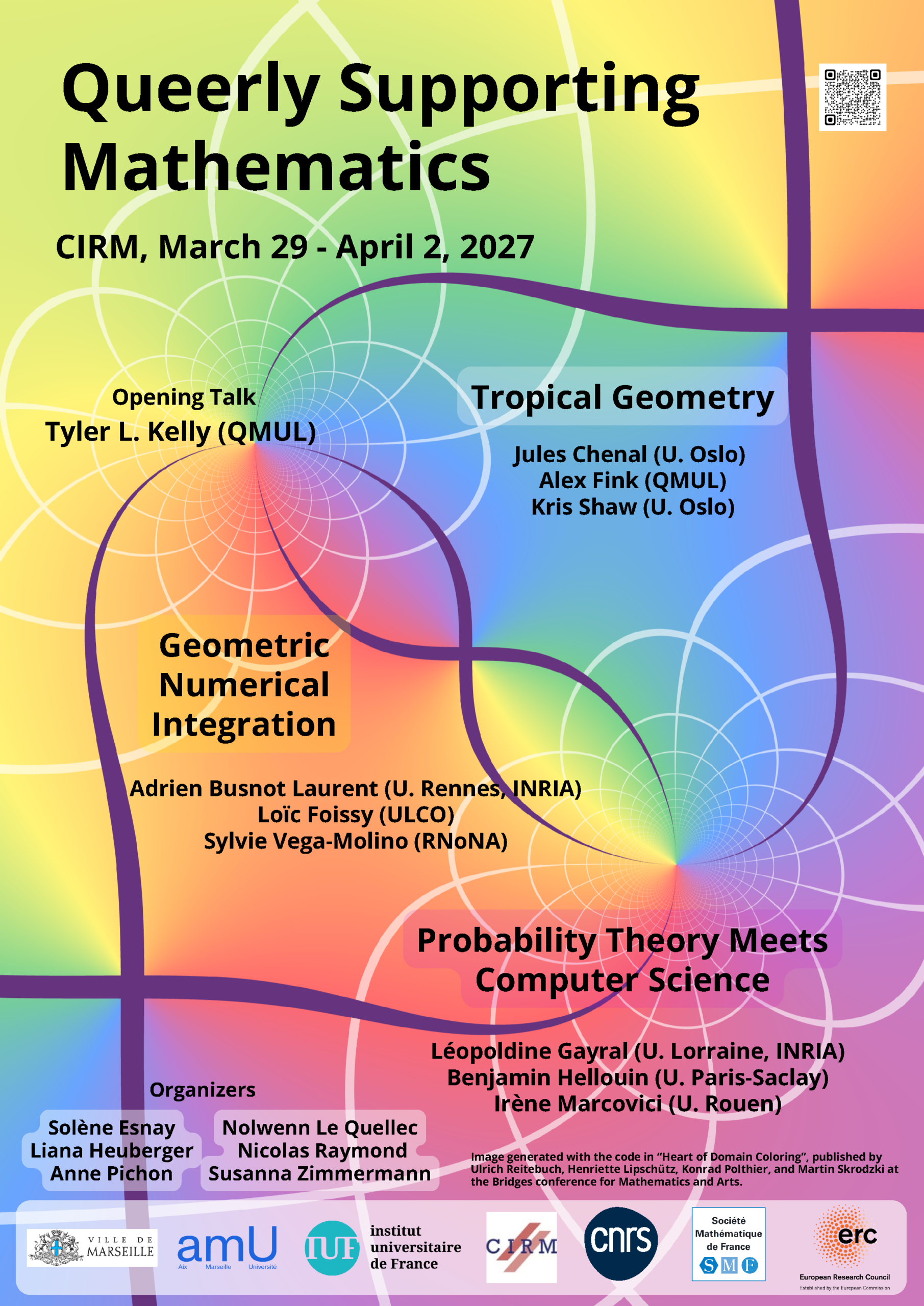
Queerly Supporting Mathematics is a one-week conference bringing together mathematicians from a wide range of backgrounds and research areas in a welcoming and inclusive environment.
The scientific program is organized around three interdisciplinary colloquia exploring recent developments at the interface of several areas of mathematics:
- Tropical Geometry: A Modern Intersection of Algebra, Geometry, and Combinatorics;
- Geometric Numerical Integration: An Overview of Recent Bridges Between Pure and Applied Mathematics;
- When Probability Theory Meets Computer Science: Random Tilings as Dynamical Systems, Combinatorial Objects, and Computation Models.
Beyond its scientific program, the conference aims to foster interactions across mathematical communities and to support LGBTQIA+ mathematicians and their allies. The program also includes discussion sessions, short contributed talks by participants, and a public outreach day devoted to mathematics and to issues of diversity and inclusion in academia. PhD students, early-career researchers, and established mathematicians who share these values are warmly encouraged to participate.
The conference is sponsored by the French Mathematical Society.
Queerly Supporting Mathematics est une conférence d’une semaine réunissant des mathématiciennes et mathématiciens issus de domaines et d’horizons variés dans un cadre accueillant et inclusif.
Le programme scientifique s’articule autour de trois colloques interdisciplinaires explorant des développements récents à l’interface de plusieurs domaines des mathématiques :
- Géométrie tropicale : une intersection moderne entre algèbre, géométrie et combinatoire ;
- Intégration numérique géométrique : panorama de liens récents entre mathématiques pures et appliquées ;
- Quand les probabilités rencontrent l’informatique : pavages aléatoires comme systèmes dynamiques, objets combinatoires et modèles de calcul.
Au-delà des mathématiques, la conférence vise à favoriser les échanges entre communautés scientifiques et à soutenir les personnes LGBTQIA+ ainsi que leurs allié·es au sein de la communauté mathématique. Le programme comprend également des sessions de discussion, des présentations courtes proposées par les participantes et participants, ainsi qu’une journée ouverte au grand public consacrée aux mathématiques et aux enjeux de diversité et d’inclusion dans la recherche. Les doctorant·es, jeunes chercheuses et chercheurs, ainsi que les mathématiciennes et mathématiciens confirmé·es partageant ces valeurs sont chaleureusement invité·es à participer.
La conférence est parrainée par la Société Mathématique de France.
Colloquium 1
Tropical Geometry: A Modern Intersection of Algebra, Geometry, and Combinatorics
• Kris Shaw (University of Olso, coordinator of the colloquium)
• Alex Fink (Queen Mary University of London)
• Jules Chenal (University of Oslo)
Tropical geometry is a rapidly developing field at the intersection of algebraic geometry, combinatorics, and optimization. It offers a new perspective on classical geometric problems by replacing the traditional operations of addition and multiplication with their ”tropical” counterparts—maxima and addition, respectively. It has applications in many field such as moduli spaces, convex geometry, and mirror symmetry, etc. In this colloquium, we will provide an overview of tropical geometry, focusing on some of its applications and connections to classical algebraic geometry, and their us in solving combinatorial and optimization problems and in understanding the geometry of toric varieties, singularities and polynomial systems.
Colloquium 2
Geometric Numerical Integration: an overview of recent bridges between pure and applied mathematics
• Adrien Busnot Laurent (Université de Rennes, INRIA, coordinator of the colloquium): introduction to geometric numerical integration
• Loïc Foissy (Université du Littoral Côte d’Opale): operads, trees, pre-Lie algebras, Hopf algebras
• Sylvie Vega-Molino (Royal Norwegian Naval Academy in Bergen): geometry, connection algebra, Riemannian approach
Geometric numerical integration is one of the most original and successful theories in numerical analysis. It relies on the use of advanced tools and interdisciplinary collaborations in algebra, combinatorics, differential geometry, and variational calculus for the study of numerical integrators that preserve geometric invariants. In this colloquium, we will present an overview of recent approaches in geometric integration, focusing on the use of pre/post-Lie and Hopf algebras and Riemannian geometry in the study of deterministic and stochastic numerical integrators on manifolds.
Colloquium 3
When Probability Theory Meets Computer Science: Random Tilings as Dynamical Systems, Combinatorial Objects and Computation Models
• Irène Marcovici (Université de Rouen Normandie, coordinator of the colloquium): word combinatorics,
probabilistic cellular automata, percolation theory
• Léopoldine Gayral (Université de Lorraine, INRIA): noisy random tilings, Gibbs measures
• Benjamin Hellouin (Université Paris-Saclay): cellular automata, randomization
In the study of discrete dynamical systems, and in particular symbolic dynamics, randomness takes many forms and motivations: invariant probability measures, measures of maximal entropy, phase transitions, random structures in cellular automata and subshifts, etc. These topics are linked to computability problems, statistical physics, combinatorics and information theory, forming a fruitful inter-disciplinary field of inquiry. We will notably discuss phase transition phenomena in random tilings described by Gibbs measures, and randomization phenomena in algebraic tilings that can be obtained as space-time diagrams of cellular automata.
SPEAKERS
Adrien Busnot Laurent (Université de Rennes & INRIA)
Jules Chenal (University of Oslo)
Alex Fink (Queen Mary University of London)
Loïc Foissy (Université du Littoral Côte d’Opale)
Léopoldine Gayral (Université de Lorraine & INRIA)
Benjamin Hellouin (Université Paris-Saclay)
Tyler L. Kelly (Queen Mary University of London)
Irène Marcovici (CNRS, Université de Rouen Normandie)
Émilie Morand (Université Laval)
Kyne Santos (Toronto Metropolitan University)
Kris Shaw ( University of Oslo)
Sylvie Vega-Molino (Royal Norwegian Naval Academy)
SPONSORS