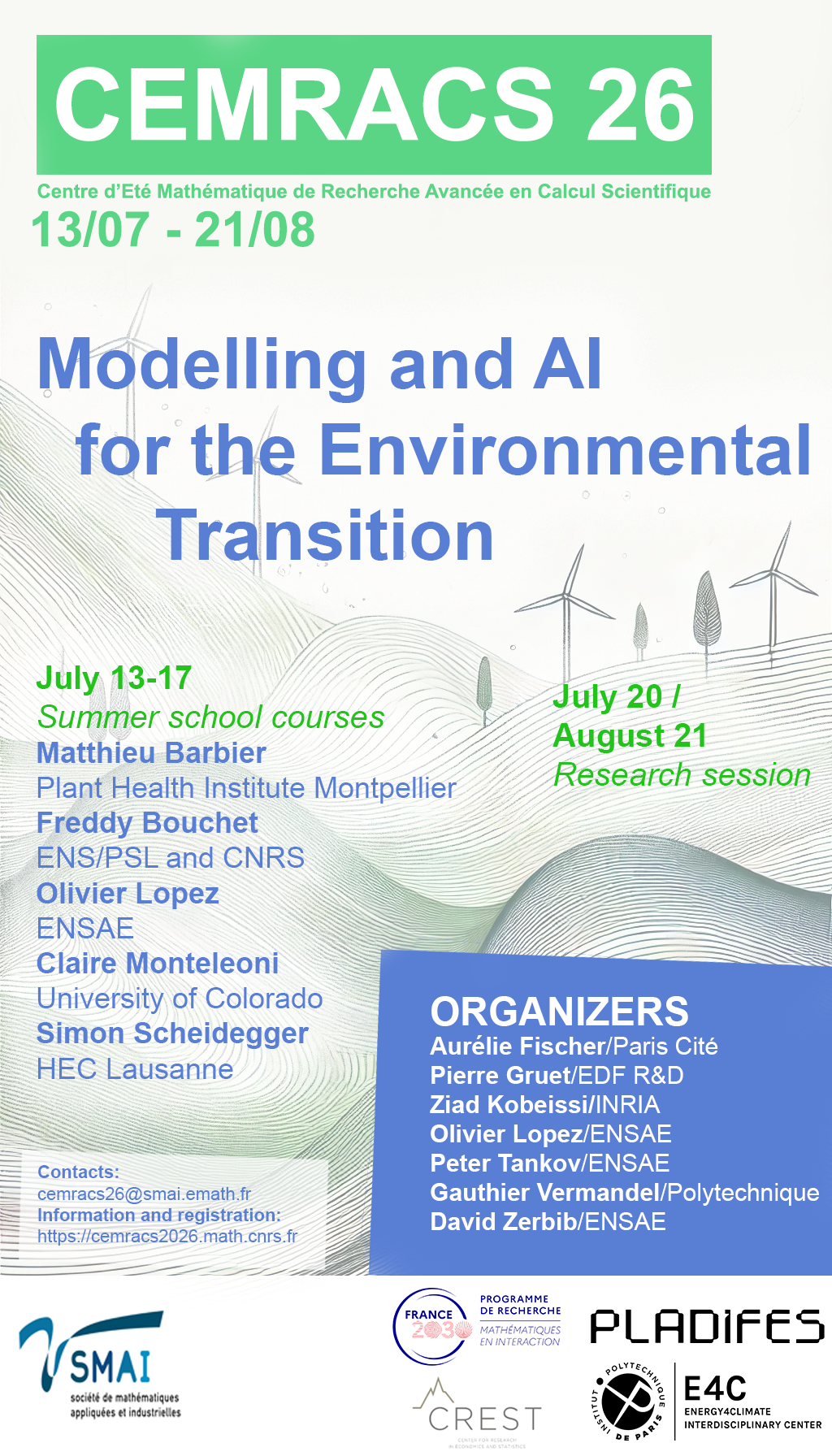
CEMRACS
Advanced research in scientific calculation
Centre d’Eté Mathématique de Recherche Avancée en Calcul Scientifique
Modeling and AI for Environmental Transition
13 July – 21 August, 2026
Scientific Committee
Comité scientifique
Freddy Bouchet (CNRS, ENS/PSL)
Emmanuele Campiglio (University of Bologna)
François Delarue (Université Côte d’Azur)
Ivar Ekeland (Université Paris Dauphine)
Emmanuel Gobet (Sorbonne Université)
Céline Guivarch (CIRED, Ecoles des Ponts)
Stéphane Loisel (LIRSA, CNAM, Paris)
Irene Monasterolo (Utrecht University)
Claire Monteleoni (University of Colorado Boulder)
Rick van der Ploeg (University of Oxford)
Organizing Committee
Comité d’organisation
Aurélie Fischer (Université Paris Cité)
Pierre Gruet EDF Lab Paris Saclay)
Ziad Kobeissi INRIA Saclay and CentraleSupelec)
Olivier Lopez (CREST Laboratory, ENSAE IP Paris)
Peter Tankov (CREST Laboratory, ENSAE IP Paris)
Gauthier Vermandel (CMAP, Ecole polytechnique)
Olivier David Zerbib (CREST Laboratory, ENSAE IP Paris)
contact: cemracs26@smai.emath.fr
Program
The principle of this event, organised by SMAI (Société de Mathématiques Appliquées et Industrielles) relies on strong industrial partnerships and has a two-period structure: the first phase consists of one week of lectures (July 15 to 19), and the second of a five-week period of project-based research. During the second phase, each participant works in a team on a collaborative research project proposed either by an industrial company or an academic team. Teams are made up of 2 or 3 young researchers, supervised by one or two experienced researchers provided by the company or academic team which proposed the project. The program includes:
- 1 week summer school (July 13-17)
- 5 weeks Hackathon / Projects on projects proposed by academic scientists and/or industrial partners (July 20 – August 21)
Topics
The urgency and complexity of the climate crisis call for contributions from many scientific domains, and the modelling challenges posed by the environmental transition call for inter- and transdisciplinary approaches, based on a multitude of data sources. At the same time, recent developments in climate science, climate economics, ecology, and other sciences dealing with environmental transition require stronger interactions of these disciplines with applied mathematics and data science to develop new models for simulating realistic scenarios, making predictions, and anticipating and controling risks.
The CEMRACS 2026 will be an interdisciplinary event, focused on mathematical, statistical, financial, actuarial, and economic modeling for the environmental transition, with a specific focus on the following domains:
- Environmental and climate economics
- Climate change adaptation and mitigation
- Insurance and reinsurance
- Energy economics and finance
- Green finance, climate-related physical and transition risks
- Ecology, biodiversity dynamics, agriculture, fisheries
- Water management
- Climate science
Summer school
This summer school focused on the bascis of quantum computer applied to various fields in sientific computation and cryptography. it aims to provide a basis knowledge for the participants that will remain on the next 5 weeks working on dedicated projects. The typical work day will consist in four one-hour-and-a-half sessions, starting at 9am, 10:45am, 2pm and 4pm. The last session may last for two hours if necessary. Each slot will be dedicated either to a classical lecture, a shorter presentation or to a computational practice session.
Minicourses
Video Lecture 1 – Introduction
Video Lecture 2 – Horizontal communities & probabilistic macroecology
Video Lecture 3 – Species interactions: randomness & structure
Research talks
Abstract:
Reconciling food security, economic development and biodiversity conservation in the face of global changes is a major challenge. The sustainable uses of marine biodiversity in the context of climate change, invasive species, water pollution and demographic growth is an example of this bio-economic challenge. There is a need for quantitative methods, models, scenarios and indicators to support policies addressing this issue. Although bio-economic models for marine resources date back to the 1950s and are still used in fisheries management and policy design, they need major improvements, extensions and breakthroughs. Our presentation designs a Mathematical Bio-Economics 2.0 (MBE2) for Sustainable Fisheries in order to advance the development of bio-economic models and scenarios for the management of fisheries and marine ecosystems confronted with unprecedented global change. These models and scenarios should make both ecological and economic senses while being well-posed mathematically and numerically. To achieve this, we propose to base the MBE2 framework for Sustainable Fisheries on four research axes regarding the mathematics and modeling of : (i) ecosystem-based f isheries management; (ii) criteria of sustainability; (iii) criteria of resilience; (iv) governance and strategic interactions. The associated methodology of MBE2 draws mainly on dynamic systems theory, optimal and viable controls of systems, game theory and stochastic approaches. Our analysis, based on these four axes, allows us to identify the main methodological gaps to fill compared to current models for fisheries management. The presentation brings together theoretical findings and applications to f isheries worldwide.
Abstract:
Arguably, water is the most important resource for mankind. It is essential from our food production down to our industrial activities. Managing our water resources has been essential for the development of our societies since ancient history. In modern society, our ability to control the availability of water is key for agriculture, life in cities, transport and energy production. These achievements are a success of engineering sciences and our ability to observe nature. Climate change is an unintentional consequence of the development of our societies. But as water is a key element of the thermodynamics of the Earth system, climate change will fundamentally alter the water cycle and our resources. As the organisation of our society is so closely linked to water availability, the impact of climate change on our resources will have wide ranging consequences. Understanding and predicting these consequences is a fundamental multi-disciplinary endeavour.
To this end the development of appropriate tools and monitor the current state and predict their future evolution in a changing climate are needed to guide our management. At the land surfaces the energy, water and carbon cycles are tightly coupled and thus one cannot be simulated without the other. In contrast to the current generation of climate models, we cannot make the assumption that the system is natural any more. Thus, we need to prepare modelling tools which also envision an evolution of how we manage our resources in an evolving system. The presentation will make the case that a new paradigm is needed which tightly couples the natural cycles with the socioeconomic constraint on the usage of the resources. This will be achieved by reviewing the current modelling strategies, their failures and how they are being overcome.
Schedule
| Monday 13/07 | Tuesday 14/07 | Wednesday 15/07 | Thursday 16/07 | Friday 17/07 | |
|---|---|---|---|---|---|
| 08h45 | Welcome | ||||
| 09:00 | |||||
| 10:30 | Coffee break | Coffee break | Coffee break | Coffee break | Coffee break |
| 10:50 | |||||
| 12:30 – 14:00 | Lunch | Lunch | Lunch | Lunch | Lunch |
| 14:00 | |||||
| 15:30 | Coffee break | Coffee break | Coffee break | Coffee break | |
| 16:30 | |||||
| 17:30 | |||||
| 18:00 | |||||
| 19:30 – 20:30 | Diner | Diner | Diner | Diner |
SPONSORS