WORKSHOP
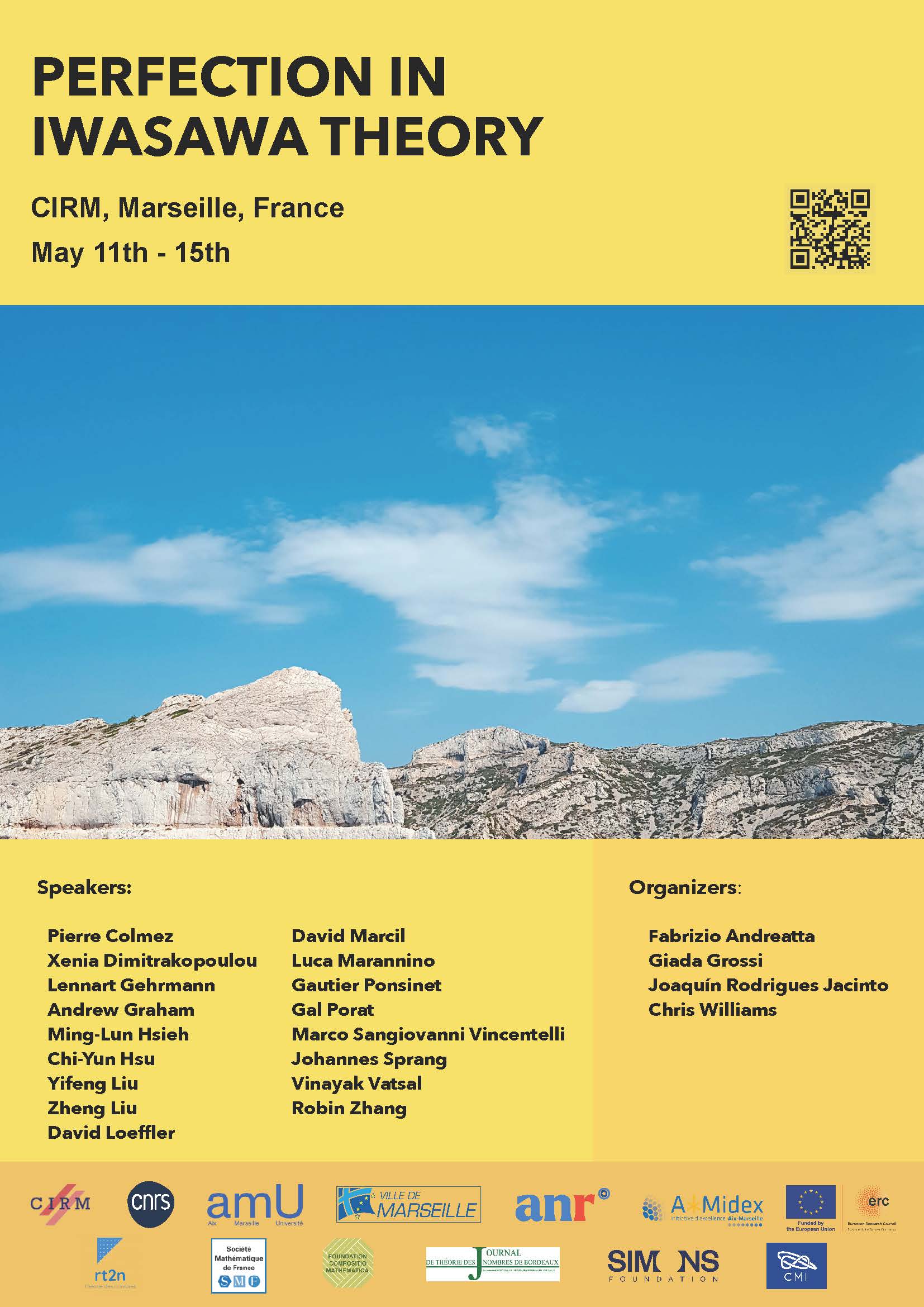
Perfection in Iwasawa Theory
Perfection en Théorie d’Iwasawa
11 – 15 May, 2026

Scientific Committee
Comité scientifique
Guido Kings (Universität Regensburg)
Antonio Lei (Université d’Ottawa)
Christopher Skinner (Princeton University)
Sarah Zerbes (EHT Zurich)
Organizing Committee
Comité d’organisation
Fabrizio Andreatta (University of Milan)
Giada Grossi (Université Sorbonne Paris Nord)
Joaquín Rodrigues Jacinto (Aix-Marseille Université)
Chris Williams (University of Nottingham)
Iwasawa theory studies the p-adic variation of arithmetic objects. It was born in a series of papers of K. Iwasawa during the mid 20th century, where he studied the growth of class groups along the cyclotomic tower, and their connection to the p-adic zeta function of Kubota and Leopoldt. This result is known as Iwasawa’s Main Conjecture and it has been generalized to many other settings (elliptic curves, modular forms, etc.).
This conference will bring together specialists of this domain to account for the latest advances in Iwasawa Theory. An emphasis will be put to the applications of perfectoid methods to the theory, such as in the construction of p-adic L-functions, or through the use of the Fargues–Fontaine curve and p-adic Hodge theory.
La théorie d’Iwasawa étudie la variation p-adique des objets arithmétiques. Elle est née au milieu du XXe siècle, dans une série d’articles de K. Iwasawa, dans lesquels il a étudié la croissance des groupes des classes le long de la tour cyclotomique, et leur lien avec la fonction zêta p-adique de Kubota et Leopoldt. Ce résultat est connu sous le nom de Conjecture Principale d’Iwasawa et a été généralisé à de nombreux autres contextes (courbes elliptiques, formes modulaires, etc.).
Cette conférence réunira des spécialistes de ce domaine afin de présenter les derniers progrès de la théorie d’Iwasawa. L’accent sera mis sur l’application des méthodes perfectoïdes à cette théorie, notamment dans la construction de fonctions L p-adiques, ou à travers l’utilisation de la théorie de Hodge p-adique et de la courbe de Fargues-Fontaine.
SPEAKERS
Marco Artusa (I2M) Towards a geometrisation of Deligne cohomology
Pierre Colmez (CNRS, Sorbonne Université) On the cohomology of (φ,Γ)-modules
Xenia Dimitrakopoulou (Aix-Marseille Université) p-adic L-functions for U(n) × U(n)
Lennart Gehrmann (Bielefeld University) Cohomology of p-arithmetic groups and p-adic L-functions
Andrew Graham (University of Oxford) Explicit reciprocity laws for twisted unitary Friedberg–Jacquet cycles
Chi-Yun Hsu (Santa Clara University) p-adic companion forms for Yoshida lifts
Yifeng Liu (Zhejiang University) Iwasawa theory for ordinary families
Zheng Liu (University of California) Yoshida lifts and congruences
David Loeffler (UniDistance Suisse) Euler systems and Selmer group bounds at non-ordinary primes
Luca Marannino (University of Milano) On recent applications of diagonal classes to anticyclotomic twists of modular forms
David Marcil (University of Oregon) p-adic L-functions for P-ordinary Hida families on unitary groups
Gautier Ponsinet (University of Duisburg-Essen) Exponential maps and Iwasawa theory
Gal Porat (Weizmann Institute of Science) Solid Locally Analytic Representations in Mixed Characteristic
Johannes Sprang (University of Duisburg-Essen) p-adic L-functions for totally imaginary fields
Vinayak Vatsal (University of British Columbia) Cyclotomic μ-invariants via (ϕ − Γ)-modules
Robin Zhang (MIT) The Stark conjectures for cyclotomic extensions of complex cubic fields
SPONSORS