

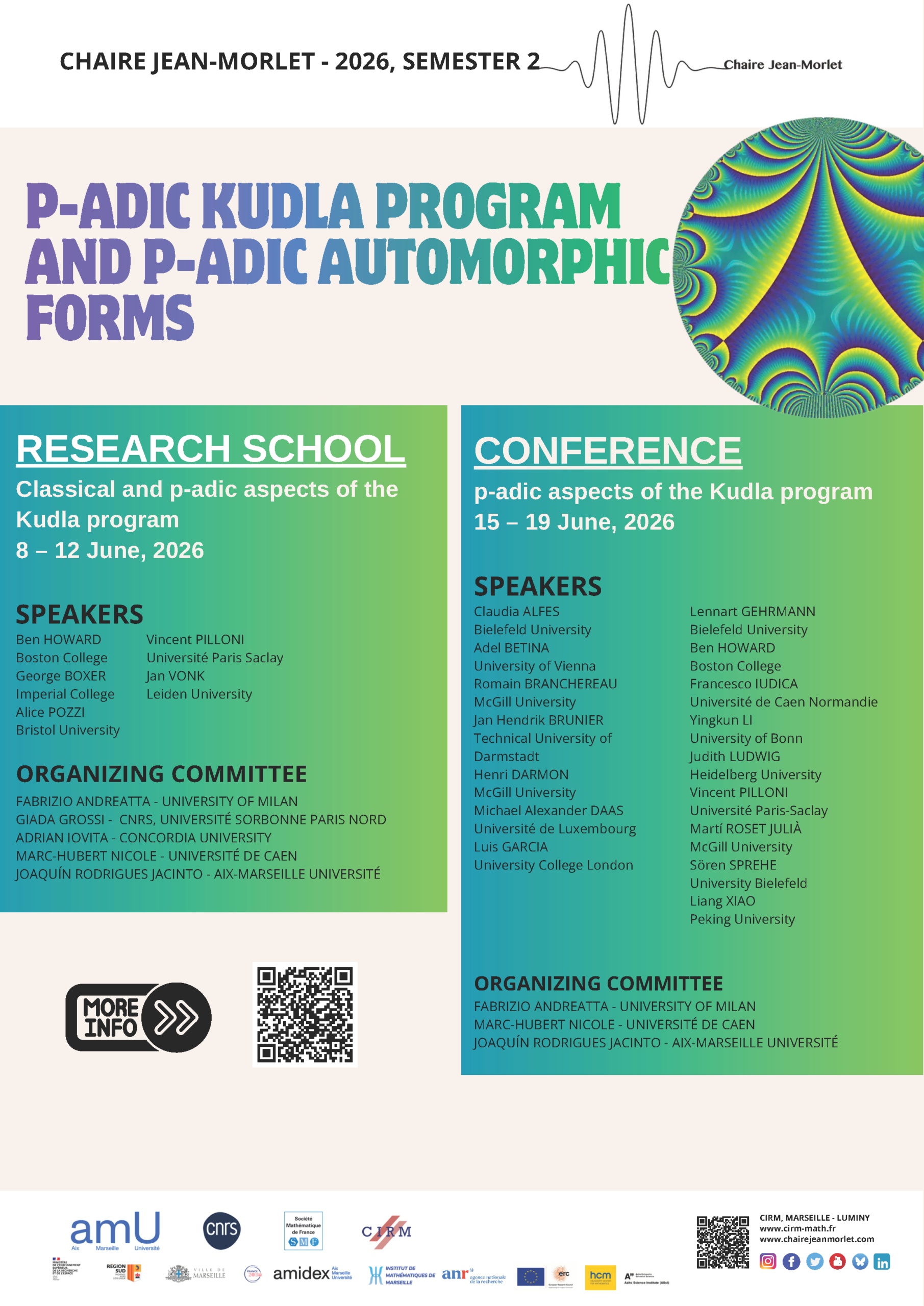
RESEARCH SCHOOL
Classical and p-adic aspects of the Kudla program
Aspects classiques et p-adiques du programme Kudla
8 – 12 June, 2026
Scientific Committee
Comité scientifique
Raphaël Beuzart-Plessis (CNRS, Aix-Marseille Université)
Stephen S. Kudla (Toronto University)
Alice Pozzi (Bristol University)
Organizing Committee
Comité d’organisation
Fabrizio Andreatta (University of Milan)
Giada Grossi (CNRS, Université Sorbonne Paris Nord)
Adrian Iovita (Concordia University)
Marc-Hubert Nicole (Université de Caen)
Joaquín Rodrigues Jacinto (Aix-Marseille Université)
The purpose of this research school will be to introduce some of the main topics that are necessary to understand the p-adic variations of arithmetic cycles and their relation to p-adic automorphic forms. It will be intended mostly for Ph.D. students and post-doctoral fellows as a preparation for the main conference. »
LECTURES
George Boxer (Imperial College) & Vincent Pilloni (Université Paris Saclay) p-adic Eichler-Shimura theory
Abstract:
Modular forms can be realized as Betti cohomology classes or coherent cohomology classes on modular curves. Eichler-Shimura theory compares both realizations. Using Betti realization, one can construct a first theory of p-adic automorphic forms : completed cohomology. Using the coherent realization we can construct another theory of p-adic automorphic forms : (higher) Coleman theory. Both theories compare, this is the p-adic Eichler-Shimura theory.
In this course we will introduce several incarnations of the p-adic Shimura varieties (classical, perfectoid, locally analytic), as well as various period morphisms (Hodge-Tate and de Rham) and use this geometry to develop the theory of p-adic automorphic forms.
References: References include work of Pan, Rodriguez Camargo, Jiang, Boxer– Calegari–Gee–Pilloni.
Ben Howard (Boston College) Arithmetic cycles and L-functions
Abstract:
These lectures are intended as an introductory course on Kudla’s program.
- Lecture 1 will focus on the origins of the theory: the work of Kudla-Millson on theta series valued in the cohomology of orthogonal symmetric spaces, at least in the case of orthogonal groups of signature (n, 2).
- Lecture 2 will focus on the work of Kudla Rapoport, Li-Zhang, and others on the arithmetic Siegel-Weil formula, relating algebraic cycles on unitary Shimura varieties to derivatives of Eisenstein series.
- Lecture 3 will focus on the work of Feng-Yun-Zhang on a higher derivative arithmetic Siegel-Weil formula on moduli spaces of unitary shtukas, and an extension of it that leads to a higher derivative Gross-Zagier style formulas over function fields.
References: There are two excellent expository articles that cover much of what I want
to say in the first two lectures: they are
(a) Stephen Kudla ”Special cycles and derivatives of Eisenstein series”,
(b) Chao Li ”Geometric and arithmetic theta correspondences”
Alice Pozzi (Bristol University) The geometry of eigenvarieties
Abstract:
The Kudla program exploits deep connections between algebraic cycles and derivatives of families of Eisenstein series. In the p-adic setting, a richer supply of p adic families is encoded by eigenvarieties — rigid analytic spaces that p-adically interpolate systems of Hecke eigenvalues arising from spaces of automorphic forms. In this course, we’ll give a brief introduction to this theory, focusing on the original example, the eigencurve constructed by Coleman and Mazur.
- Lecture 1: Construction of eigenvarieties. We will introduce Buzzard’s general formalism for constructing eigenvarieties, the so-called eigenvariety machinery. We will then specialise to the case of the Coleman–Mazur eigencurve.
- Lecture 2: First properties of the eigencurve. We will discuss key properties of the eigencurve: the density of classical points, reducedness, and the family of pseudorepresentations over the eigencurve.
- Lecture 3: Local geometry at classical points. We will discuss results on the local geometry of the eigencurve at classical points, with particular focus on the geometry at classical weight-one points as described by Bella¨ıche and Dimitrov. We will then discuss the connections to p-adic transcendence theory and the arithmetic of S-units in number fields, as well as their applications.
Prerequisites: Familiarity with rigid analytic spaces, at the level of Several Approaches to Non-Archimedean Geometry (B. Conrad).
References:
(a) Eigenvarieties (K. Buzzard)
(b) The Eigenbook (Ch. 3 and Ch. 7, J. Bellaïche).
Jan Vonk (Leiden University) Singular moduli for real quadratic fields
Abstract:
In this course, we will explore the work of Gross and Zagier on differences of singular moduli and heights of Heegner points over imaginary quadratic fields, as well as recent p-adic constructions whose goal is to exhibit similar structures in the more mysterious setting of real quadratic fields.
References:
(a) AWS 2007 lecture notes on the p-adic upper half plane (Dasgupta – Teitelbaum):
https://swc-math.github.io/aws/2007/DasguptaTeitelbaumNotesMar10.pdf
(b) PCMI notes on rigid cocycles:
https://pub.math.leidenuniv.nl/ vonkjb/publications/PCMI.pdf
SPONSORS
